
Termites are the top structural pest problem in many new construction homes due to their ability to establish early, often undetected colonies. Regardless of whether it is a home, business or industrial building, protecting the foundation from termites should be considered when planning construction. In cities like Ahmedabad, with warm climates and varied soil types, it becomes more important to prevent termites. Choosing a pre or post-construction Termite Control Treatment in Ahmedabad at the correct stage, early post-construction, can significantly reduce the chances of structural long-term deterioration and repair expenses.
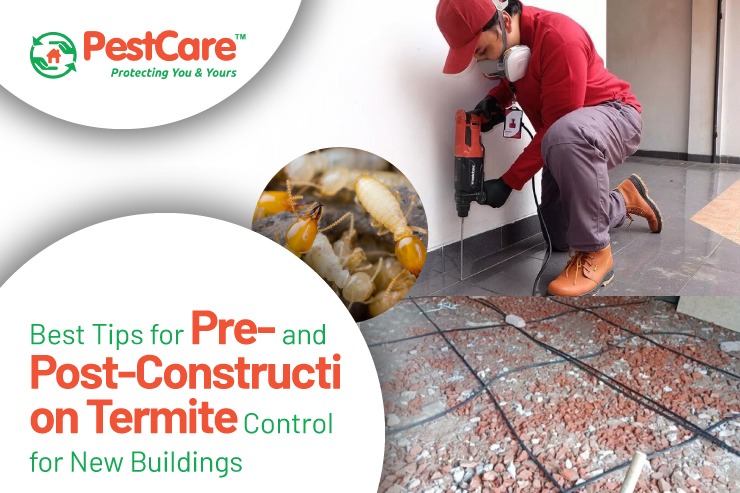
This post will elaborate on what pre- and post-construction termite control is, how it works, and what to consider for the construction of new buildings.
Termites live underground and travel through soil and wood to access cellulose-rich foods, including wood, paper or certain fixtures in buildings. They commonly gain access to buildings from expansion joints, cracks in foundations, plumbing lines and unfinished concrete surfaces.
Even newly constructed buildings are not impervious to termites. The fact that termites can easily detect and thrive on disturbed soil during construction means that if precautionary measures aren’t taken in time, it can lead to termite infestation.
Pre-construction termite treatments are preventative measures implemented before the construction and installation of your flooring.
The goal is to create a physical or chemical barrier between the earth and the building, preventing termites from accessing the structure.
The soil type and moisture level are a few variables that must be checked before using any chemical treatment. Clay, loamy and sandy soils will not respond the same to termite pesticides, and adjustments in dosing may be needed.
If not applied thoroughly, termites can find gaps and voids created by partial treatment. The entire foundation, both interior and exterior perimeters, should be treated equally.
Termites frequently enter through expansion joints, service pipe entrances, and wall-to-floor junctions. During the construction preparation phase, additional work is done in these areas.
Only government-approved termite insecticides should be used. Those used as guidelines are evaluated for safety and efficacy.
When the floor is done, pre-construction has no effect. Long-term protection is time-sensitive.
Post-construction termite control takes place after a structure has been constructed and occupied. Typically used when :
This approach is curative, and not preventive, but may still offer good control when used correctly.
Bathrooms, kitchens and woodwork, basements and outside walls are usually more vulnerable as they can hold moisture and have hidden access points.
Excess moisture attracts termites. Good perimeter drainage means that the last thing you’re offering the pests is a wet home.
Surface Sprays do not eradicate termite nests. Good control requires soil injection and structural uses.
Inspection occasionally after post-treatment helps prevent invasion from untreated surfaces.
| Aspect | Pre-Construction | Post-Construction |
|---|---|---|
| Timing | Before the foundation and flooring | After building completion |
| Purpose | Prevention | Control and correction |
| Application | Soil treatment | Drilling and injection |
| Effectiveness | Long-term prevention | Depends on the infestation stage |
Both techniques have their own uses, and the decision will depend on the construction phase and level of infestation.
The weather conditions of Ahmedabad, a heterogeneous soil texture and high-expanding urban construction allow termites to spread and thrive. Much development takes place on reclaimed or previously disturbed land, often increasing termite exposure. Good planning of termite control protects structures from damage over time.
You can save yourself from costly fixes in the future by avoiding these blunders.
You can have termites control as a one-time project, but this will be an ongoing process that starts when the residence is being built and then persists into everyday operation. Practical preventive control is to treat before buildings are constructed, and where the problem exists, to use post-construction treatment. By learning how each method works with the team at Pest Care Limited, you can make an informed decision so you are taking good care of your investment.